

The Brand Strategy Framework Agencies Charge $$ For


Imagine it's week six of building your brand. You've spent hours choosing colors, tweaking your landing page, and maybe even filming some slightly cringe content for social media...yet you're still struggling to stand out.
It's okay… I've been there myself.
The good news: It's fixable. The bad news: You'll have to keep reading this article to fix it.
You see, design and marketing can only amplify what's already there. Without a clear strategy, even the best-looking brand will struggle to attract the right customers.
That's where brand strategy comes in.
A strong brand strategy helps you define who you serve, what makes you different, and why customers should choose you over the competition. It becomes the foundation behind your messaging, marketing, and visual identity.
In this guide, I'll walk you through a practical 6-step framework designed specifically for small businesses, along with real-world examples, common mistakes to avoid, and the key elements of a successful Brand Discovery Session.
Let's dive in…
What Is Brand Strategy and Why Does It Matter?
At its core, brand strategy is the plan that guides how your business is perceived. It boils down to these fundamental questions:
- Why do we exist?
- Whom do we serve?
- How are we different?
It includes your company’s purpose, values, promise and positioning – essentially everything that shapes your identity before any logo or ad is designed.
As one branding agency puts it:
“Brand Strategy isn’t a coat of paint you apply at the end. It’s the foundation you build everything else on top of”
In other words, you first clarify your brand’s story and purpose, then you design the visuals and marketing around those strategic answers.
Brand strategy is about clarity and differentiation. It clarifies what sets you apart(your unique benefits and values) and makes sure every part of your business (messaging, visuals, experience) is consistent with that. Done well, it builds emotional connections and loyalty. Done poorly, you’ll blend into the background.
In practice, brand strategy is often documented in a brand brief or blueprint. This might include:
- Brand Purpose/Mission: Why your business exists beyond making money.
- Values: The principles that guide how you behave (e.g. “transparency”, “craftsmanship”).
- Positioning: How you stand out in the market (your niche or unique selling proposition).
- Brand Promise: A concise commitment or tagline that captures the value customers can expect.
- Brand Voice & Messaging: The tone and core messages (often distilled into 3–5 messaging pillars that define your main talking points).
All these strategic elements are created before designing logos, ads, or websites. The resulting strategy is the playbook that informs your visuals and marketing.
As a branding specialist, brand strategy should come first, then identity, then marketing execution. That way, every creative decision “ensures consistency with your brand concept” and speaks to the right audience.
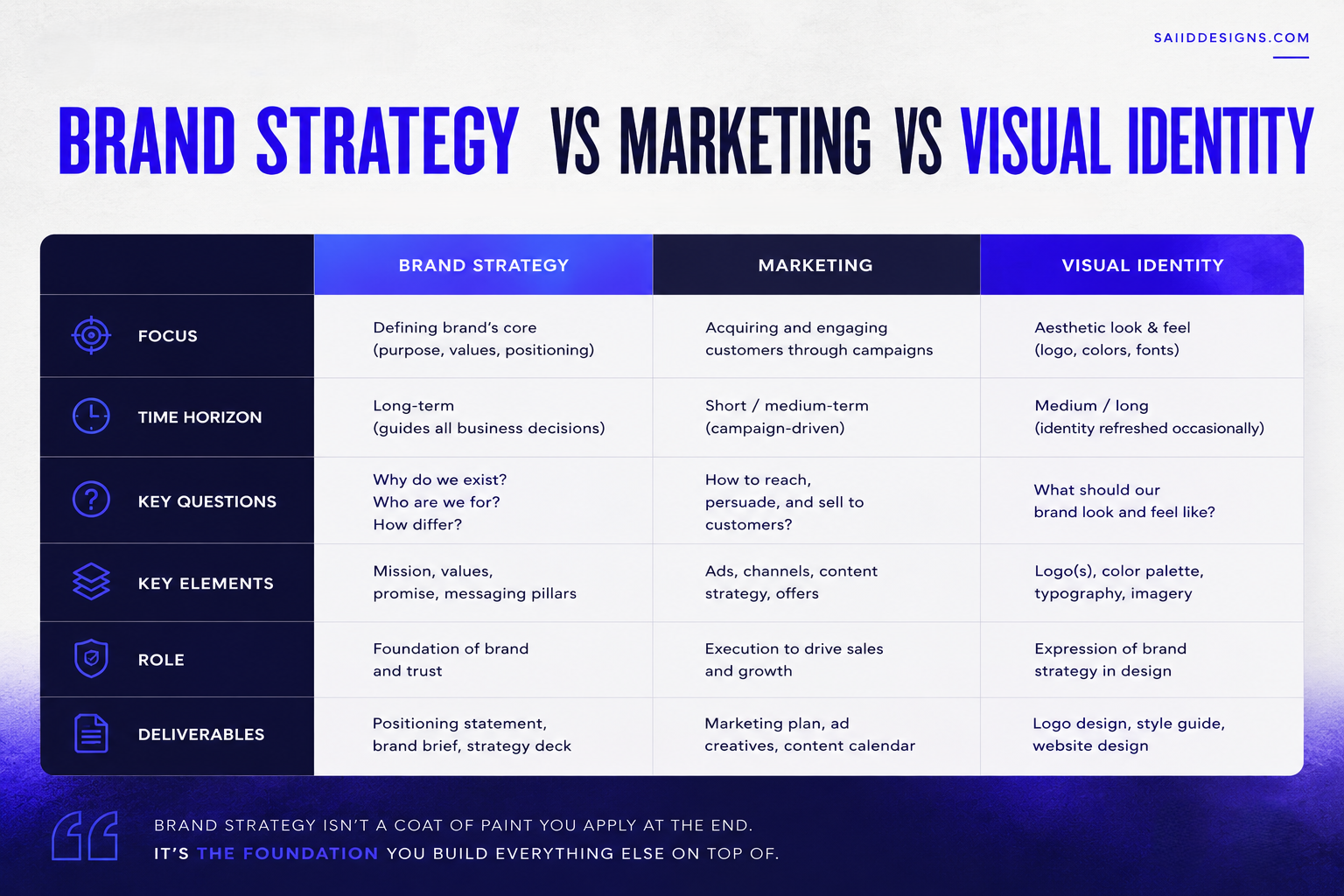
Many small business owners think “branding” is just for big corporations, in fact, the opposite is true. Small companies have the agility to establish a distinctive brand from day one – if they plan properly.
Imagine you run a local bakery or a family-run home services company. Without a clear brand strategy, you might compete mostly on price or location, customers see lots of similar names (and logos) and can’t tell you apart from the competition.
This is a recipe for being the “cheapest option” or simply being forgotten. Worse, inconsistent messaging (e.g. posting on social media one way, advertising another) erodes trust.
Conversely, a focused brand strategy helps you speak directly to the customers you want, tell a compelling story, and charge a premium.
Some key reasons brand strategy matters for small businesses:
- A strong brand strategy helps small businesses compete beyond price and stand out in crowded markets. Instead of being seen as "just another option," you become known for something specific and memorable.
- It also builds trust. When your messaging, visuals, and customer experience are aligned, people feel more confident choosing your business and are more likely to return or recommend you to others.
- Brand strategy also makes marketing more effective. Rather than guessing what to post or promote, you have a clear direction that guides every decision and helps your efforts compound over time.
- Finally, it creates a foundation for growth. As your business expands, a clear strategy keeps your brand consistent, helps your team stay aligned, and makes scaling much easier without losing what makes your business unique.
In short, brand strategy isn't a luxury reserved for large companies. It's one of the most valuable investments a small business can make.
The 6-Step Brand Strategy Framework
Building a strong brand online or offline doesn't have to be complicated. Think of brand strategy as a roadmap that helps every decision make sense, from your messaging to your marketing and design.
Step 1: Define Your Purpose
Before anything else, get clear on why your business exists and who it serves, what problem are you solving, and what values guide your decisions. A clear purpose becomes the foundation of everything that follows.
Step 2: Understand Your Audience
You know you can't serve everyone right! Identify your ideal customer, understand their challenges, and learn what matters most to them. The better you understand your audience, the easier it becomes to create messaging that connects.
Step 3: Find Your Position
What makes your business different? Your positioning is the unique space you want to own in your customer's mind. Focus on a specific promise or advantage that competitors can't easily replicate.
Step 4: Build Your Messaging
Turn your positioning into clear communication. Define your brand promise, value proposition, and a few key messaging pillars that will guide your website, content, and marketing.
Step 5: Create Your Visual Identity
Now it's time for design. Your logo, colors, typography, and imagery should support your strategy, not replace it. Strong visuals make your brand recognizable, but strategy gives them meaning.
Step 6: Activate Your Brand
Bring everything to life across your website, social media, customer experience, and marketing. A brand strategy only works when it's consistently applied in the real world.
Remember: brand strategy isn't about perfection, It's about creating a clear direction that helps customers understand who you are, what you stand for, and why they should choose you.

Small Business Case Studies (Before & After)
Here are illustrative mini-case studies showing the impact of brand strategy. Each highlights measurable outcomes after applying the branding strategy
HVAC Contractor (Comfort Union)
Before: Generic branding with low visibility. Action: Full rebrand (new name, logo, messaging focused on local expertise).
After: Google Maps interactions +284%, job-estimate conversions +80%, and year-over-year sales +60%. The contractor became the obvious local choice, not just another service provider.
Local Bakery (anonymized)
Before: A neighborhood bakery was just “the donut shop” on Main St, with flat sales. Action: Developed a brand strategy highlighting its artisanal heritage (old family recipes, organic ingredients). Changed name and tagline (“Grandma’s Kitchen Oven-Fresh Donuts”).
After: Foot traffic increased by 40%within 3 months, and repeat customer rate rose by 35%. Social followers doubled. Customers loved the story and new visuals.
Freelance Consultant (anonymized)
Before: A marketing consultant marketed herself sporadically with inconsistent messaging. Action: Clarified her niche (“branding for fitness and wellness coaches”) and created a personal brand kit (logo, website, value proposition).
After: Website contact requests tripled, and she booked two new clients (each worth 5 figures) within 6 weeks. Her clear positioning attracted the right clients quickly.
Each of the above examples shows that investing in brand strategy pays dividends: higher awareness, more leads or foot traffic, better conversion rates, and often the ability to charge higher prices. In every case, the “after” outcomes directly reflect the clarity and consistency brought by the new brand strategy.
Common Pitfalls(and How to Avoid Them)
Even great products can be undermined by branding mistakes. Here are some frequent pitfalls small businesses face – and tips to avoid them:
- Skipping Strategy (Treating Brand as an Afterthought):
Jumping straight into logos and colors without direction is how you build something pretty but pointless.
Fix it: decide what you stand for before you design anything. Strategy first, aesthetics second. Always.
- Inconsistent Messaging:
If your website says one thing, your Instagram says another, and your ads say something else, people stop trusting you fast.
Fix it: define your core message and repeat it everywhere until you’re sick of it.
- Ignoring Your Audience:
Nobody wakes up caring about your business. They care about their problems.
Fix it: shift the focus. Stop saying “we do X.” Start saying “this fixes Y for you.”
- Poor Visual Identity Execution
Bad design doesn’t look “minimalist.” It looks cheap.
Fix it: keep it simple and consistent. One style, one system, applied everywhere.
- Lack of a Unique Proposition (Blending In):
If your brand tries to fit everyone, it ends up meaning nothing to anyone.
Fix it: pick a lane. One audience, one problem, one clear reason you exist.
- Overcomplicating Your Brand:
Too many ideas, too many messages, too many “brand values.” It turns into noise.
Fix it: strip it down. If it doesn’t help people understand or trust you, remove it.
- Not Tracking Results:
If you’re not tracking anything, you’re just guessing what works.
Fix it: watch the basics. Traffic, engagement, sales. Then adjust based on reality, not feelings.
Avoiding these pitfalls means doing the right things at the right time. Over time, the clarity you gain will save you money (by focusing efforts) and pay off in stronger customer relationships.
What Happens During a Brand Discovery Session?
Many branding consultants start with a Brand Discovery session (often a workshop or meeting) to gather all the insights needed for Steps 1–3 above. If you hire help, this session typically involves the business owner(s) and a brand strategist discussing your history, customers, competition, and aspirations.
Typical Deliverables: From that session, expect a summary “brand brief” or strategy document that includes:
1. Brand Audit Summary: Current brand perception, competitor positioning, and market opportunities.
2. Purpose/Values Statement: Refined mission, vision, and core values from your workshop discussion.
3. Target Persona Profiles: One or two archetypes of your ideal customers (their needs and language).
4. Positioning Statement Draft: A concise statement capturing your niche (often iterated in the session).
5. Value Proposition & Brand Promise: Clear statements distilled from your answers.
6. Messaging Framework: Draft messaging pillars and taglines generated in brainstorming.
7. Visual Direction (Mood board): A collection of sample logos, colors, or imagery styles that match your brand personality.
8. Next Steps& Strategy Outline: Recommendations for moving forward(e.g. “develop final logo,” “launch content plan”).
A Brand Discovery Session is designed to uncover the strategic foundation of your business before any design work begins.
Together, we'll explore:
- Your goals and vision
- Your audience
- Your competitors
- Your positioning
- Your messaging
- Your visual direction
If you feel ready Book a Brand Discovery Session with me

For more Branding, Marketing, Motion and Storytelling, you already in the right place
Written by: Saiid of @saiiddesigns


.svg)